What Is Probability?
Have you ever wondered why weather forecasters say there’s a “70% chance of rain”? Or why casinos always seem to win in the long run? The answer lies in one simple concept: probability.
Probability is part of our daily life, even if we don’t notice it. From flipping a coin to deciding whether to carry an umbrella, we use probability more often than we realize.
In this article, we’ll break down probability in the simplest way possible, with real examples you can relate to.
What Is Probability in Simple Terms?
Probability is the branch of mathematics that deals with the chance of something happening.
In simple words, probability tells us how likely an event is to occur.
It is usually expressed as a number between 0 and 1, or as a percentage between 0% and 100%.
- A probability of 0 means the event will never happen.
- A probability of 1 (or 100%) means the event will definitely happen.
- A probability of 0.5 (or 50%) means there’s an equal chance of the event happening or not happening.
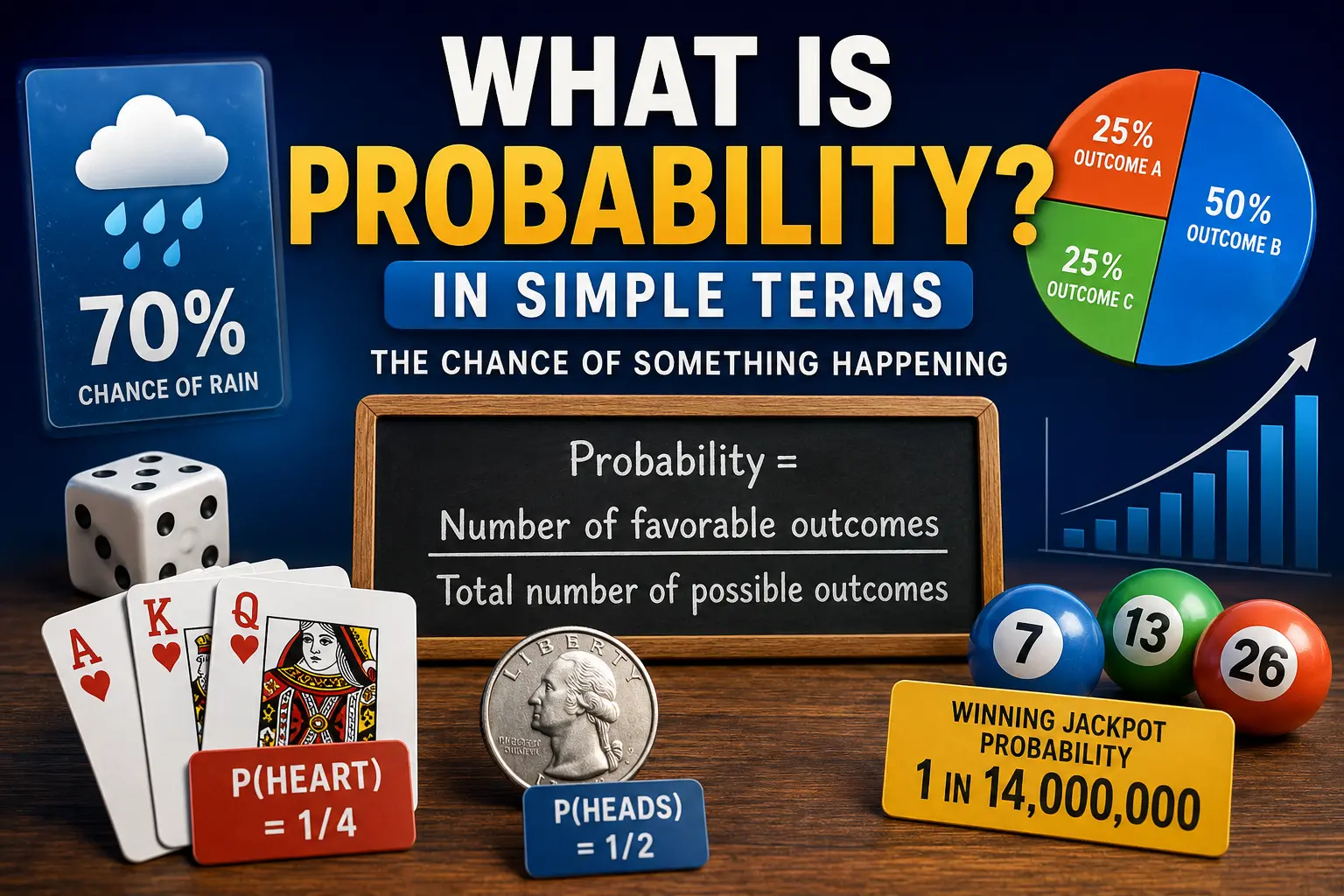
For example, when you flip a fair coin, there are two possible outcomes: heads or tails. Since both outcomes are equally likely, the probability of getting heads is 1/2, or 50%.
The basic formula for probability is:
Probability = (Number of favorable outcomes) / (Total number of possible outcomes)
This simple formula is the foundation of an entire field of mathematics used in science, finance, medicine, and even artificial intelligence.
Why Probability Matters
Probability isn’t just a school subject. It plays a major role in how the world works.
Insurance companies use probability to decide how much to charge for car or health insurance. They calculate the likelihood of accidents or illnesses based on historical data.
Doctors use probability to estimate the risk of diseases and the effectiveness of treatments. For instance, a clinical trial might show that a new medicine reduces symptoms in 80% of patients.
Weather scientists use probability models to predict rain, storms, or heatwaves. When you see “70% chance of rain,” it means that under similar weather conditions in the past, it rained 70% of the time.
Even technology companies use probability. Algorithms behind Netflix recommendations, Google search rankings, and spam filters all rely on probability and statistics.
Understanding probability helps us make smarter, more informed decisions instead of relying purely on guesswork.
Real-Life Examples
Let’s look at a few everyday examples to make probability easier to understand.
Example 1: Rolling a Dice
A standard die has six sides, numbered 1 to 6. The probability of rolling a 4 is 1/6, because there’s only one favorable outcome out of six possible outcomes.
Example 2: Drawing a Card
A deck of cards has 52 cards. The probability of drawing a heart is 13/52, which simplifies to 1/4, since there are 13 hearts in the deck.
Example 3: Weather Forecasting
If meteorologists say there’s a 30% chance of rain tomorrow, it means that in similar past conditions, rain occurred about 30 out of 100 times.
Example 4: Lottery Tickets
Winning a lottery jackpot often has extremely low probability, sometimes as small as 1 in 14 million. This explains why lottery wins are so rare, even though millions of people play.
These examples show that probability isn’t abstract. It’s a practical tool that explains outcomes we see every day.
Probability in Everyday Decisions
We use probability-based thinking constantly, even without doing any math.
When you decide whether to carry an umbrella, you’re estimating the probability of rain based on the sky or weather app.
When a doctor recommends a treatment, they’re weighing the probability of success against possible side effects.
When you choose a faster route to avoid traffic, you’re estimating the probability of congestion based on experience.
Investors and traders use probability to assess risk before buying stocks. A higher probability of growth (based on company performance, market trends, and economic indicators) often guides investment decisions.
Even sports analysts use probability to predict match outcomes by analyzing team performance, player statistics, and historical data.
In short, probability helps us navigate uncertainty in a logical and structured way, rather than relying on pure luck.
Common Misconceptions
Many people misunderstand probability, leading to poor decisions. Let’s clear up a few common myths.
Myth 1: “If something hasn’t happened in a while, it’s due to happen soon.”
This is known as the gambler’s fallacy. For example, if a coin lands on heads five times in a row, many people assume tails is “due” next. But each coin flip is independent; the probability remains 50% every single time.
Myth 2: “A 90% chance of success means it will definitely happen.”
A 90% probability is high, but it still leaves a 10% chance of failure. Treating high probability as certainty can lead to risky decisions.
Myth 3: “Probability and possibility are the same thing.”
Something can be possible but have an extremely low probability. Winning the lottery is possible, but the probability is tiny.
Myth 4: “Past results guarantee future outcomes.”
In games of pure chance, like dice or coins, past results don’t influence future ones. Each event is typically independent unless stated otherwise.
Understanding these misconceptions helps us think more clearly about risk, chance, and decision-making.
Probability and Number-Guessing Games
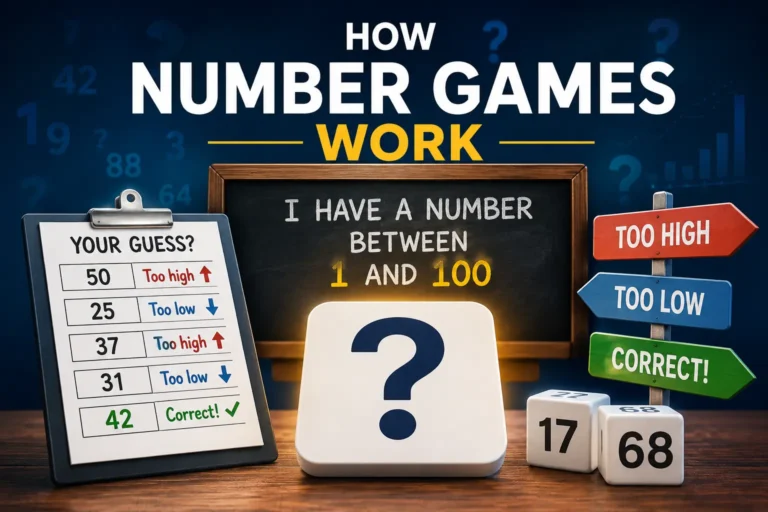
Many people search for ways to “predict” outcomes in number-based games like Kolkata Fatafat, satta, or lottery draws. It’s worth understanding what probability actually says about these games.
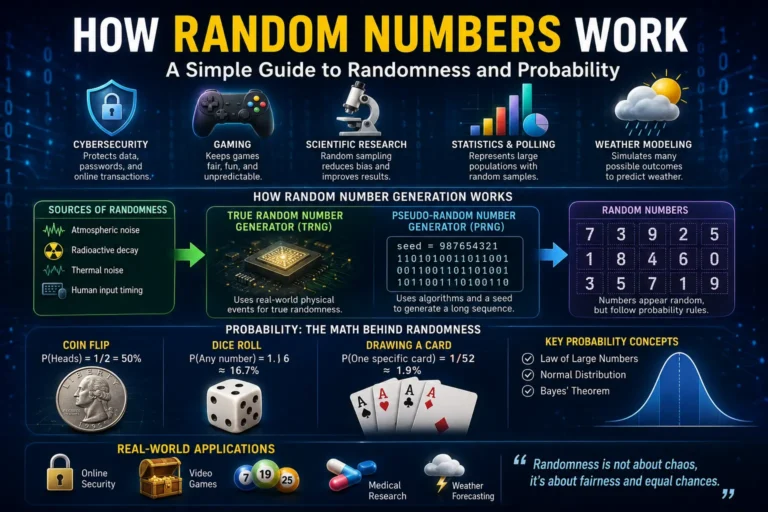
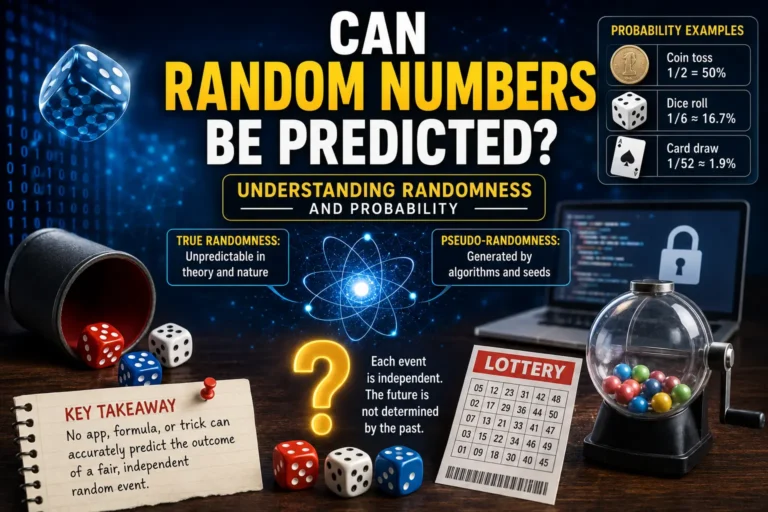
These games are typically based on random number generation. Each draw is an independent event, meaning the outcome of one round has no mathematical connection to the round before or after it.
This means there is no formula, pattern, or “hot number” that can reliably predict the next result. If a number hasn’t appeared in several draws, it is not “due” to appear soon, this is the gambler’s fallacy described earlier in this article.
Websites or individuals claiming to offer “guaranteed” number predictions are not using real probability or mathematics. Genuine probability can only describe long-term likelihoods based on truly random processes; it cannot forecast a single specific outcome with certainty.
It’s also worth noting that games involving money and chance carry real financial risk. Understanding probability can help people recognize that consistent winning through prediction is not mathematically possible in a fair, random game, which is an important fact for making informed, responsible decisions.
If you or someone you know struggles with gambling-related stress, it may help to speak with a counselor or a trusted support service in your area.
FAQs
1. What is probability in simple words?
Probability is a way of measuring how likely something is to happen. It’s expressed as a number between 0 (impossible) and 1 (certain), or as a percentage.
2. What is an example of probability in real life?
Weather forecasts are a common example. A “60% chance of rain” means rain is likely based on similar historical weather patterns.
3. What is the formula for probability?
The basic formula is: Probability = Number of favorable outcomes ÷ Total number of possible outcomes.
4. Why is probability important in daily life?
Probability helps us make informed decisions in areas like health, finance, weather planning, and risk assessment, rather than relying on guesswork.
5. Is probability the same as statistics?
No. Probability predicts the likelihood of future events, while statistics analyzes past data to find patterns and trends. Both fields are closely connected and often used together.
Conclusion
Probability is simply a way of measuring chance and uncertainty in numbers. From weather forecasts to medical decisions, financial risks, and even our daily choices, probability quietly shapes the world around us.
Understanding the basics, like favorable outcomes, total outcomes, and common misconceptions, can help you think more clearly and make smarter decisions.
You don’t need to be a mathematician to understand probability. With simple examples like coins, dice, and weather predictions, anyone can grasp how likely events truly are.
The next time someone mentions a “70% chance” of something, you’ll know exactly what that means and why it matters.