Can Random Numbers Be Predicted?
Have you ever watched someone roll a dice and wondered, “What number will come next?” Most of us have. Random numbers show up everywhere — in dice games, lottery draws, weather models, and even in the security codes that protect our bank accounts. But the big question stays the same: can random numbers really be predicted?
The short answer is: sometimes yes, sometimes no, and it depends on what “random” actually means. Let’s break this down in simple terms.
What Does “Random” Really Mean?
In everyday language, we use the word “random” loosely. We say things like “that was so random” when something surprises us. But in math and science, randomness has a stricter meaning.
A process is called random when its outcome cannot be known in advance, and no pattern reliably repeats itself. A coin toss is a common example. Before you flip it, you cannot be sure if it will land on heads or tails. Each flip is independent of the last one.
There are two broad types of randomness that experts talk about:
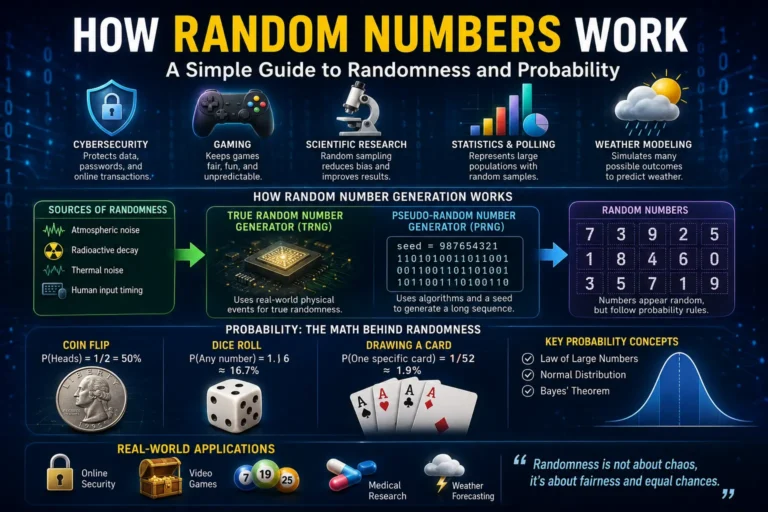
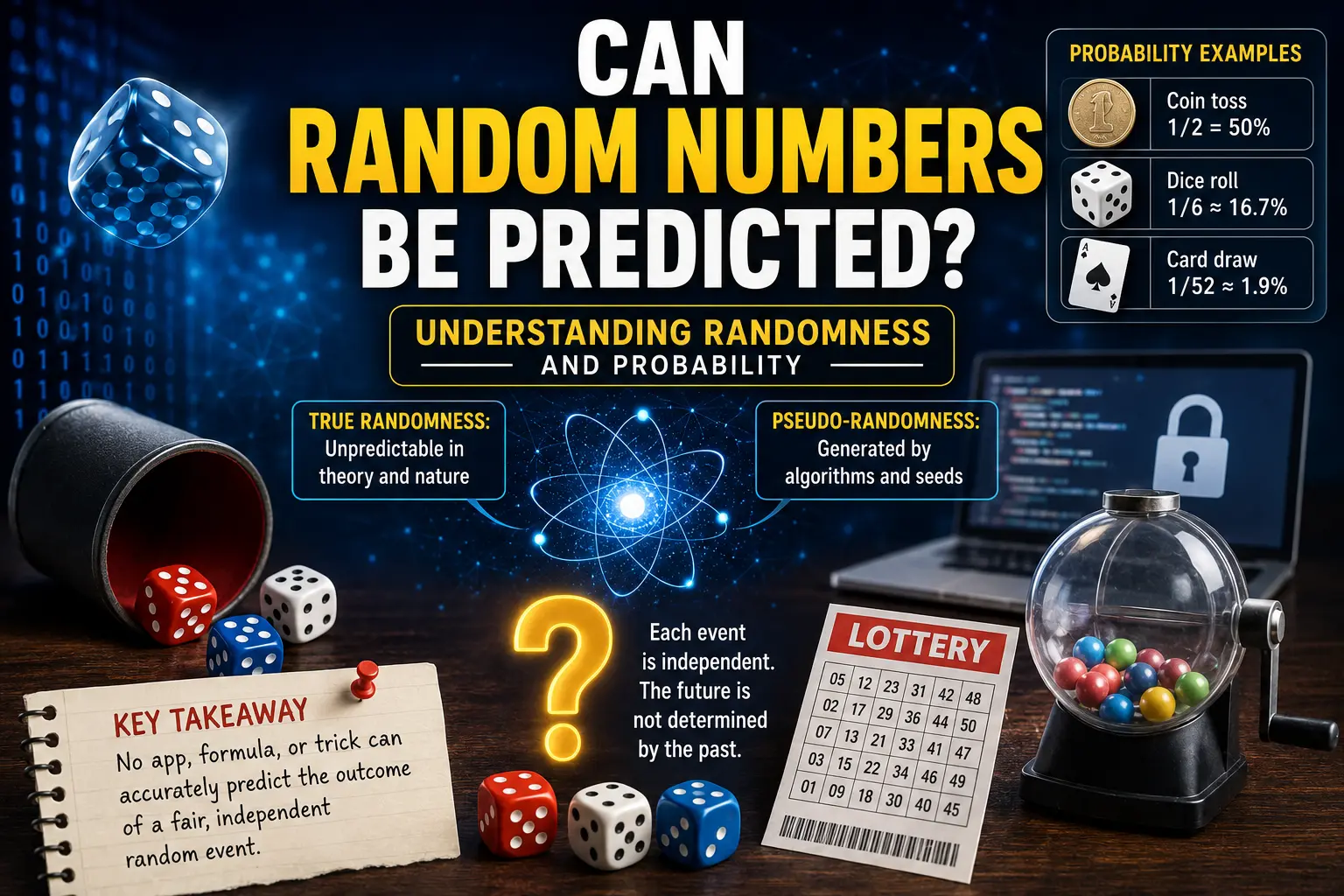
- True randomness – comes from natural, physical events, like radioactive decay or atmospheric noise. These are considered unpredictable even in theory.
- Pseudo-randomness – created by computer algorithms called random number generators (RNGs). These numbers look random but are actually produced using a mathematical formula and a starting value called a “seed.”
This difference matters a lot when we talk about prediction.
Understanding Probability in Simple Words
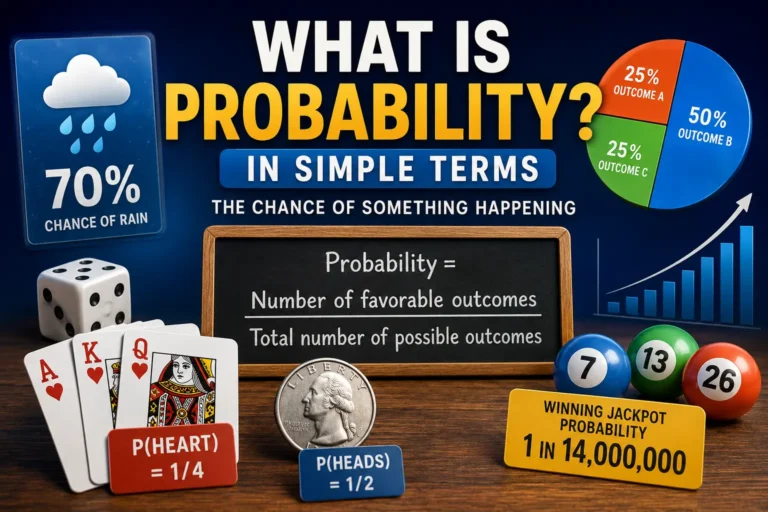
Probability is the branch of mathematics that measures how likely something is to happen. It is usually written as a number between 0 and 1, or as a percentage.
For example:
- The probability of a fair coin landing on heads is 1 in 2, or 50%.
- The probability of rolling a specific number on a six-sided dice is 1 in 6, or about 16.7%.
- The probability of picking a specific card from a 52-card deck is 1 in 52.
Probability does not tell you what will happen next. It tells you what is likely to happen if you repeat an event many times. This is called the law of large numbers. Over a few tries, results can look uneven. But over thousands of tries, the outcomes tend to balance out close to the expected probability.
Can Computers Predict Random Numbers?
Here is where things get interesting. Computers do not generate “true” randomness on their own. Most everyday software uses pseudo-random number generators (PRNGs). These follow a fixed mathematical rule, so if you know the starting seed and the formula, you can predict every number that follows.
This is why PRNGs are fine for things like video games or simple simulations, but not safe enough for serious security tasks like encryption. For sensitive applications, engineers use cryptographically secure random number generators (CSPRNGs), which pull unpredictable data from real-world sources such as mouse movement, hardware noise, or atmospheric static. These are extremely hard to predict, even with powerful computers.
Scientists have also built devices called hardware random number generators (HRNGs) that use quantum effects, like the behavior of photons, to create numbers that are considered truly unpredictable by the laws of physics.
Why Human Brains Are Bad at Randomness
Interestingly, humans are naturally poor at both creating and predicting random numbers. Studies in psychology and behavioral science show that when people try to write down a “random” sequence of numbers, they unconsciously avoid repeating digits or create patterns that feel random but statistically aren’t.
This happens because our brains are wired to search for patterns. It’s a survival skill — useful for spotting danger in nature, but not helpful when true randomness is needed. This is one reason lottery machines, dice, and computer algorithms are trusted over human guessing.
The Limits of Predicting Random Numbers
So, can random numbers be predicted? It depends on the source:
- Truly random physical events (radioactive decay, quantum noise) — Not predictable, even in theory, according to current scientific understanding.
- Pseudo-random computer sequences — Predictable if you know the algorithm and seed, but usually not predictable without that information.
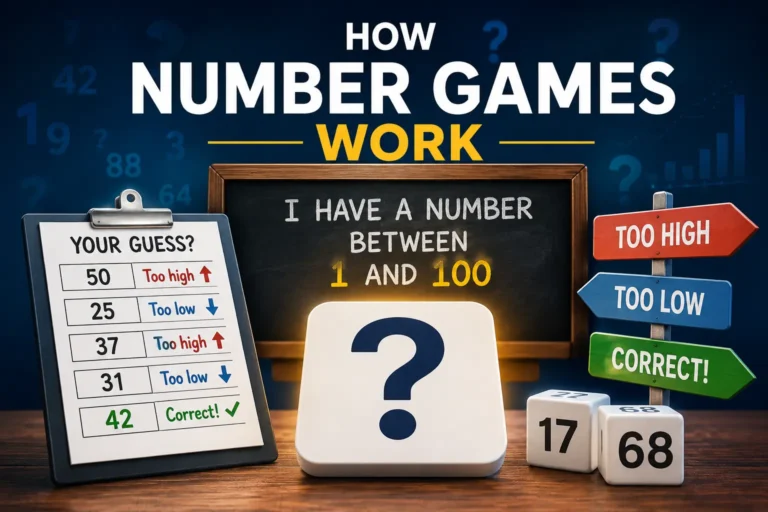
- Human-based number guessing games — Not mathematically predictable, since each draw is typically independent of the last, similar to a coin toss or dice roll.
No app, formula, or “trick” can accurately predict the outcome of a fair, independent random event. Anyone claiming to have a guaranteed method to predict such outcomes is going against basic principles of probability.
A Look at Kolkata Fatafat: An Informational Note
Kolkata Fatafat is a well-known local numbers-based result game that many people in and around Kolkata, India, are familiar with, and it is often discussed in the context of everyday number-guessing culture. Like other numeric draw formats, it involves a set of results announced multiple times a day.
From a mathematical standpoint, such number draws function similarly to other independent random events. Each round is generally treated as a separate event, meaning that previous results do not influence future ones — this is the same principle seen in coin tosses or dice rolls. Statisticians studying such games usually point out that there is no verified mathematical formula that can consistently predict the next outcome, since the process is designed to be unpredictable by nature.
This article does not offer any prediction methods, tips, or strategies related to Kolkata Fatafat or similar games. The mention here is purely to explain how randomness and probability apply to real-world number-based systems that many people encounter in daily life.
Why This Topic Matters
Understanding randomness and probability isn’t just useful for games. It helps in:
- Making sense of weather forecasts
- Understanding risk in insurance and finance
- Evaluating scientific research and statistics
- Building secure passwords and online systems
- Thinking critically about claims of “guaranteed” prediction methods
Knowing the difference between true randomness and predictable patterns can help anyone become a smarter, more informed reader of everyday information.
Frequently Asked Questions
1. Is anything truly random? According to current physics, yes. Quantum events, like radioactive decay, are considered genuinely random and unpredictable, even with perfect information.
2. Can a computer generate real random numbers? Standard computer programs generate pseudo-random numbers, which follow a formula. Some specialized hardware devices, however, use physical processes to generate numbers considered truly random.
3. Why do humans struggle to think of random numbers? Our brains are naturally pattern-seeking, so numbers we pick “randomly” often follow hidden habits, unlike numbers generated by machines or physical processes.
4. Does probability help predict a single random event? Not exactly. Probability describes the likely pattern over many repeated events, not the outcome of one single try.
5. Can past results predict future ones in a random draw? No. In most well-designed random systems, each draw is independent, meaning earlier results do not affect what comes next.
Final Thoughts
Randomness is one of the most fascinating ideas in mathematics and science. While pseudo-random computer sequences can sometimes be predicted with enough technical knowledge, truly random events — whether from nature or advanced hardware — remain unpredictable. Probability gives us a way to understand patterns over time, but it can never promise a certain outcome for a single event. This is what makes randomness both mysterious and mathematically important.