
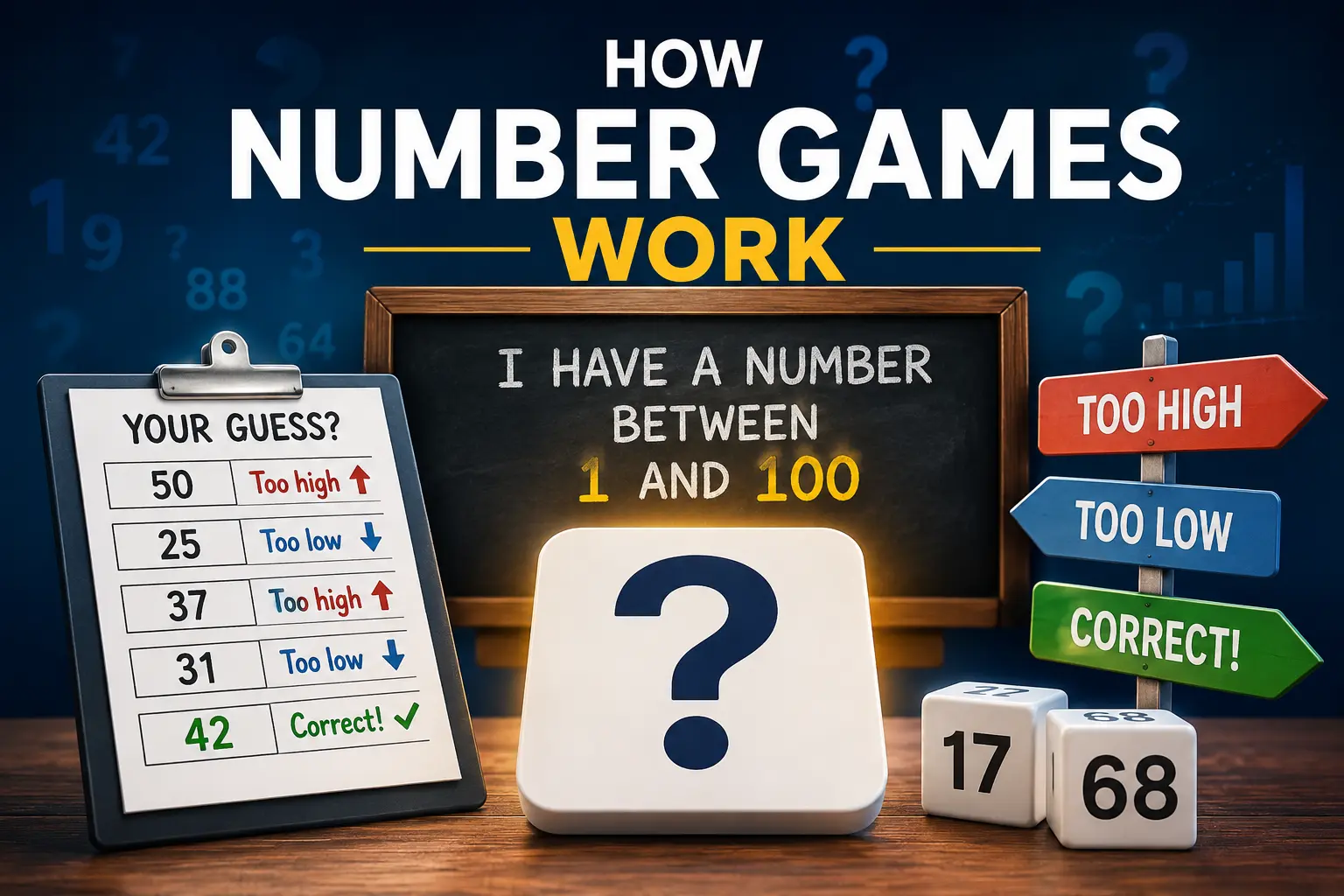
How Number Games Work
Have you ever tried to guess a number and wondered how these games actually work? Whether it is a simple game between friends or a more structured format, number-guessing games have fascinated people for centuries. They seem simple on the surface, but a lot is going on behind the scenes.
This article breaks down how number-guessing games work in plain, simple language — no complicated math required.
What Are Number Games?
A number guessing game is exactly what it sounds like. One party selects a number, and another party tries to guess it. The game can be as basic as a friend picking a number between 1 and 10, or it can involve more complex systems with wider ranges and structured rules.
These games appear in many forms. Children play them in classrooms. Programmers use them as beginner coding exercises. Game shows have built entire formats around them. At their core, they all share the same basic idea: a number is chosen, and someone has to figure out what it is.
What makes them interesting is that the guesser has no direct knowledge of the chosen number. They rely entirely on the information available to them — such as hints, logic, or pure chance.
The Basic Rules Behind Number Games
Most number games follow a simple structure. Here is how a typical version works:
A range is defined first. For example, the number could be anywhere between 1 and 100. This range tells the guesser the boundaries they are working within.
Next, a number is selected from within that range. In a game between two people, one person picks the number mentally. In digital versions, a computer or program selects it.
The guesser then makes a guess. Depending on the game type, they might receive feedback — such as “too high” or “too low” — or they might get no feedback at all and simply find out if they were right or wrong.
The game ends when the correct number is guessed or when a set number of attempts runs out.
These rules seem straightforward, but the mechanics underneath them involve concepts like probability, logic, and randomness.
How Random Number Selection Works
One of the key elements of a number-guessing game is how the number gets chosen. In human-to-human games, one person just picks a number. But in digital or automated games, a system called a random number generator (RNG) is used.
An RNG is a process — usually a computer algorithm — that produces numbers without any predictable pattern. When a program needs to pick a number between 1 and 50, the RNG selects one in a way that does not follow a set sequence.
There are two main types of random number generators:
True Random Number Generators (TRNGs) use physical phenomena — like electrical noise or atmospheric data — to produce genuinely unpredictable numbers.
Pseudo-Random Number Generators (PRNGs) use mathematical formulas to simulate randomness. While they are not truly random, they produce sequences that are statistically hard to distinguish from true randomness in most practical settings.
For most number-guessing games, PRNGs are more than sufficient. The result is a number that the guesser has no reliable way of knowing in advance.
Why Outcomes Cannot Be Predicted Accurately
This is a question many people ask: can someone get good at guessing numbers?
In theory, with hints like “higher” or “lower,” a smart player can use a strategy called binary search to narrow down the answer efficiently. For example, if the range is 1 to 100, guessing 50 first and adjusting based on the feedback cuts the possibilities in half with every guess. This is logical and effective when hints are provided.
However, when no hints are given — just a flat “right or wrong” — then the outcome is almost entirely down to chance. No strategy can reliably identify a specific number in a large range without additional information.
This is because randomness is, by its nature, not predictable. A number chosen at random does not remember what was chosen before. Each selection is independent. Even if the number 37 was chosen ten times in a row (which is statistically very unlikely but theoretically possible), the next number has an equal chance of being anything in the range.
This concept is sometimes called statistical independence, and it is a fundamental property of properly randomised games.
The Role of Probability and Chance
Probability is the mathematics of likelihood. In number-guessing games, it tells us how likely a guess is to be correct.
If the range is 1 to 10 and one number is chosen, then any single guess has a 1 in 10 chance (10%) of being right. Expand the range to 1 to 100, and the probability drops to 1 in 100 (1%).
Probability does not guarantee outcomes. It describes what is likely over a large number of attempts. If you played the same 1-to-10 game one hundred times and guessed the number 7 every time, you would expect to be correct around 10 times — but it might be 8, or 12, or even fewer. Probability gives averages, not certainties.
This is why number-guessing games are considered games of chance when no hints are provided. Luck plays a significant role, and skill can only go so far without additional information.
Common Misconceptions About Number Games
There are a few ideas that many people believe about number-guessing games that are simply not true.
“Some numbers come up more than others.” In a properly randomised system, every number in the range has an equal probability of being selected. No number is “due” to appear, and no number is “overdue.”
“You can spot patterns over time.” With a true or well-designed pseudo-random system, past results do not create patterns that can reliably predict future results. Looking for patterns in random data is a cognitive bias known as apophenia — the human tendency to find connections where none exist.
“Gut feelings or intuition give an advantage.” There is no scientific evidence that intuition improves accuracy in genuinely random selection processes. What feels like intuition is often pattern recognition, which does not apply when outcomes are truly random.
“More attempts always improve your long-term results.” More attempts give more chances, but they do not improve the odds of any single guess. Each guess in a random game stands on its own.
Risks and Responsible Participation
Number-guessing games are generally harmless when played casually. However, when they are part of any kind of structured activity involving money or real-world stakes, it is important to approach them with clear thinking.
Because outcomes in random number games cannot be predicted, no strategy guarantees success. Spending significant time, energy, or resources on any activity that relies purely on chance carries real risk.
If you or someone you know feels unable to stop participating in chance-based activities or feels distressed about the outcomes, it is a good idea to speak to a trusted person or seek support from a professional.
Keeping any number game fun and low-stakes is the best way to enjoy it responsibly.
Frequently Asked Questions
1. Can I improve my chances of guessing the right number?
When hints like “higher” or “lower” are given, using a logical strategy — like guessing the midpoint of the remaining range each time — can help you reach the answer faster. Without any hints, however, every guess has the same probability regardless of strategy.
2. Are number-guessing games truly random?
In digital games, using a well-designed random number generator, yes. The numbers are selected in a way that is statistically unpredictable. In human-played games, the selection may be influenced by personal preference, but proper randomisation removes this factor.
3. What is binary search in number games?
Binary search is a smart strategy for guessing games where feedback is given. You start in the middle of the range, and after each hint, you move to the middle of the remaining possible range. It is the most efficient way to find a number with the minimum number of guesses.
4. Why do I sometimes feel like I am “close” to guessing right?
This is a normal human experience. Our brains are wired to look for patterns and assign meaning to events. Feeling close to a correct guess is a psychological experience, not a reliable signal of accuracy in a random system.
5. Are number games educational?
Yes, they are widely used in education. They teach concepts like probability, logic, and algorithmic thinking. Programmers often build number-guessing games as an early coding project because they involve core programming ideas in a simple, understandable format.
Conclusion
Number-guessing games are a brilliant example of how simple rules can lead to rich, interesting outcomes. At their heart, they work by combining a random selection process with the human desire to find answers through logic and intuition.
Understanding how number-guessing games work means understanding randomness, probability, and the limits of prediction. A chosen number has no memory, no preference, and no pattern — and that is precisely what makes these games both challenging and fair.
Whether you are playing one for fun, studying it in school, or building your own version as a coding exercise, the core mechanics remain the same. Every guess is a small exercise in probability, and every outcome is shaped by the elegant unpredictability of chance.