How Random Numbers Work: A Simple Guide to Randomness and Probability
Have you ever shuffled a music playlist and wondered how your phone picks the next song? Or maybe you’ve played an online card game and asked yourself if the deck was really shuffled fairly.
Behind both of these everyday moments is a fascinating idea: randomness. Let’s explore how random numbers are created, why they matter, and how probability ties it all together.
What Is Randomness?
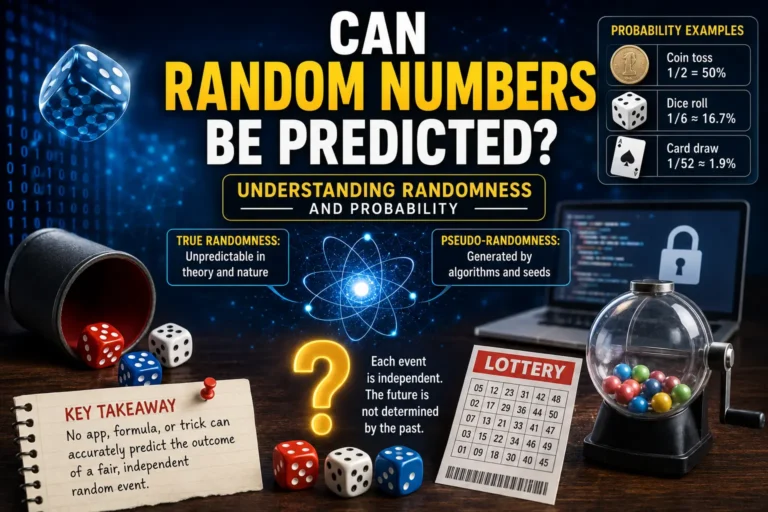
Randomness means there’s no way to predict what happens next. Every possible outcome has a chance of occurring, but none of them are guaranteed.
Think about flipping a coin. You don’t know in advance if it will land on heads or tails. Each flip is independent of the last one.
Some everyday examples of randomness include:
- The number you roll on a dice
- Which card you draw from a shuffled deck
- Raindrops falling in unpredictable patterns
- Traffic light timing at certain intersections
Mathematicians and computer scientists describe this unpredictability using probability theory, a branch of mathematics that measures how likely an event is to happen.
Why Random Numbers Matter
Random numbers aren’t just a fun coding trick. They power some of the most important systems in modern life.
Cybersecurity: Encryption keys, passwords, and secure online transactions rely on randomness. Without it, hackers could predict security codes and break into accounts.
Gaming and Entertainment: Slot machines, video games, and online casinos use random number generators (RNGs) to keep outcomes fair and unpredictable.
Scientific Research: Clinical trials often use random sampling to assign participants to different groups. This reduces bias and improves the reliability of results.
Statistics and Polling: Organizations like Gallup and Pew Research use random sampling techniques to represent large populations accurately, sometimes surveying just a few thousand people to estimate the opinions of millions.
How Random Number Generation Works
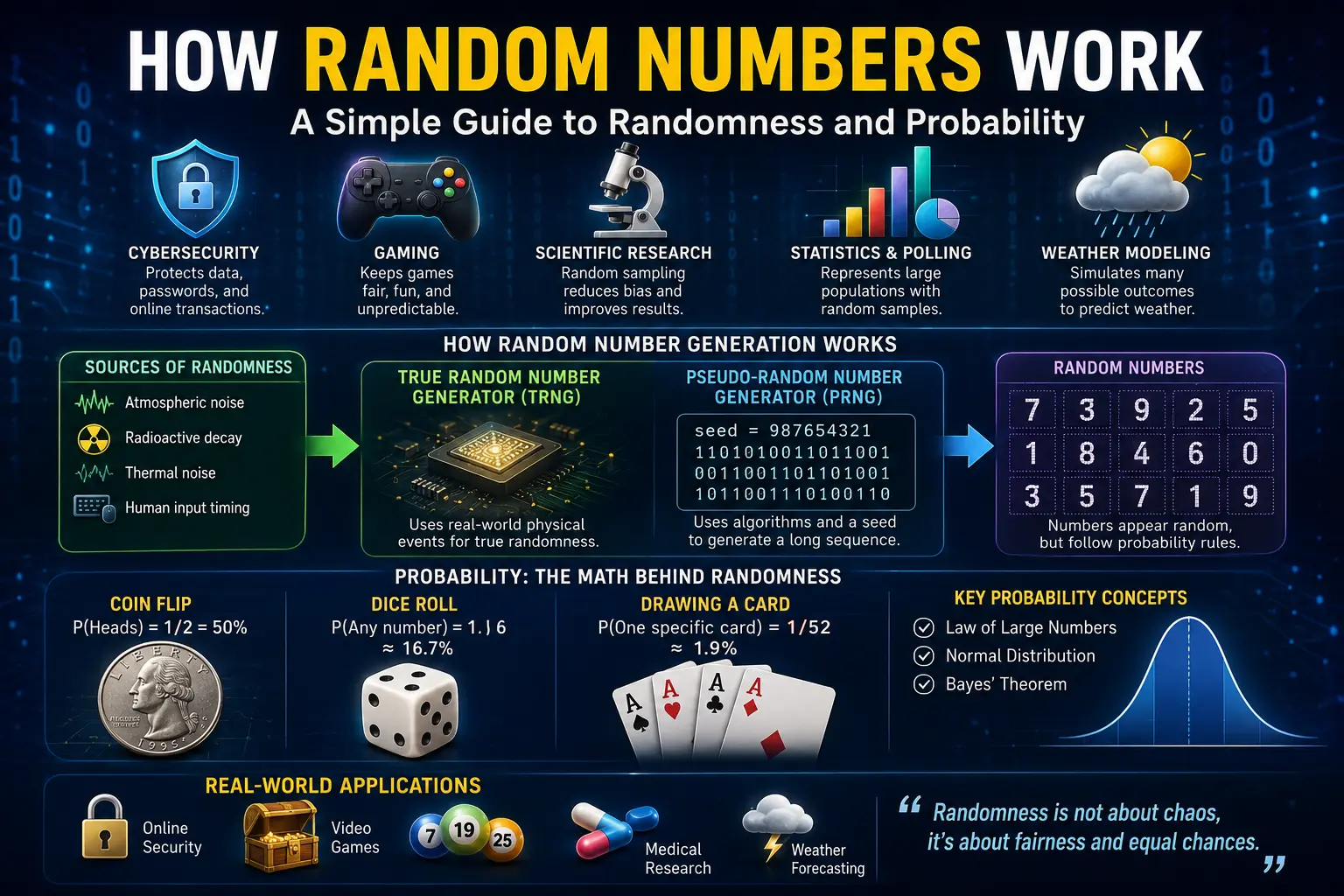
There are two major categories of random number generators: true random number generators (TRNGs) and pseudo-random number generators (PRNGs).
True Random Number Generators (TRNGs)
TRNGs create randomness from real-world physical events. These are sometimes called “hardware random number generators” because they rely on natural, unpredictable processes such as:
- Atmospheric noise
- Radioactive decay
- Thermal noise in electronic circuits
- Timing variations in mouse or keyboard input
Random.org, a popular online service, generates true random numbers using atmospheric noise captured through radios. Many lotteries and research institutions trust this method because it doesn’t rely on any predictable formula.
Pseudo-Random Number Generators (PRNGs)
Most everyday computer systems use pseudo-random number generators instead. A PRNG uses a mathematical algorithm to produce a long sequence of numbers that appear random, even though they’re generated through a fixed formula.
Here’s the key detail: a PRNG starts with a value called a “seed.” If you used the exact same seed twice, you’d get the same sequence of numbers both times.
To avoid predictability, computers usually generate seeds using unpredictable inputs, like the exact system time in milliseconds or background hardware noise.
One well-known PRNG algorithm is the Mersenne Twister, widely used in programming languages like Python and R for simulations and general-purpose randomness.
Cryptographically Secure Random Number Generators (CSPRNGs)
For high-security needs, ordinary PRNGs aren’t enough. That’s where CSPRNGs come in.
CSPRNGs are designed so that even if part of the sequence is exposed, attackers still can’t predict future numbers. Standards organizations like NIST (National Institute of Standards and Technology) publish strict guidelines for these systems, which are used in:
- Banking transactions
- Password generation
- Digital certificates
- Secure messaging apps like Signal
Real-World Examples of Random Numbers
Online Shopping: When you check out on a secure website, your browser generates a random cryptographic key to protect your card details.
Video Games: Loot boxes, enemy spawn points, and dice-based mechanics rely on RNGs to keep gameplay fresh and unpredictable each time you play.
Lottery Draws: Many national lotteries use TRNG-based hardware systems to select winning numbers, ensuring results can’t be manipulated.
Medical Research: In a randomized controlled trial, researchers might assign 500 patients randomly into treatment and control groups, helping isolate the true effect of a new drug.
Weather Modeling: Meteorologists run simulations using random sampling to predict a range of possible weather outcomes, rather than a single fixed forecast.
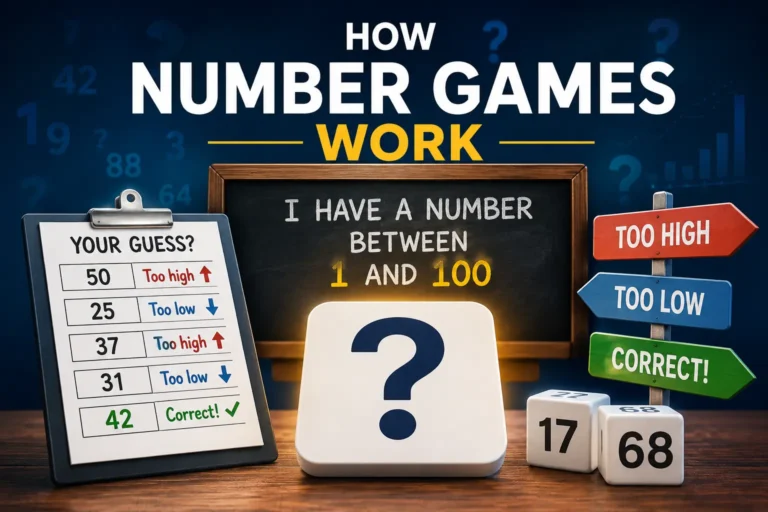
A Quick Look at Kolkata Fatafat and Number-Guessing Games
Kolkata Fatafat, often called Kolkata FF, is a well-known example of how randomness shows up in everyday culture, especially in West Bengal, India. It’s a fast-paced number-guessing game where players select numbers and place bets based on their prediction, winning cash prizes if their chosen numbers match the declared results.
What sets it apart from a typical lottery is its speed. Each round is called a Bazi, and a complete result consists of a three-digit Patti number, with the sum of its digits producing the final single-digit result. The game runs eight rounds a day from Monday to Saturday, and four rounds on Sunday, giving players several chances throughout the day to guess the outcome.
From a purely mathematical angle, this kind of game relies on the same core idea covered earlier in this article: unpredictability. Since each round’s result is meant to be independent of the one before it, no past outcome can reliably predict the next one, much like a dice roll or a coin flip.
It’s worth noting that the legal and regulatory status of privately run number games like this varies by source and region, and different reports describe it differently. Kolkata Fatafat is not operated by the government but runs privately, and is viewed by some as an unauthorized private betting game. Because of this, it’s best understood here as general cultural and mathematical information rather than encouragement to participate, and anyone interested should stay mindful of local laws around betting and gambling.
Probability: The Math Behind Randomness
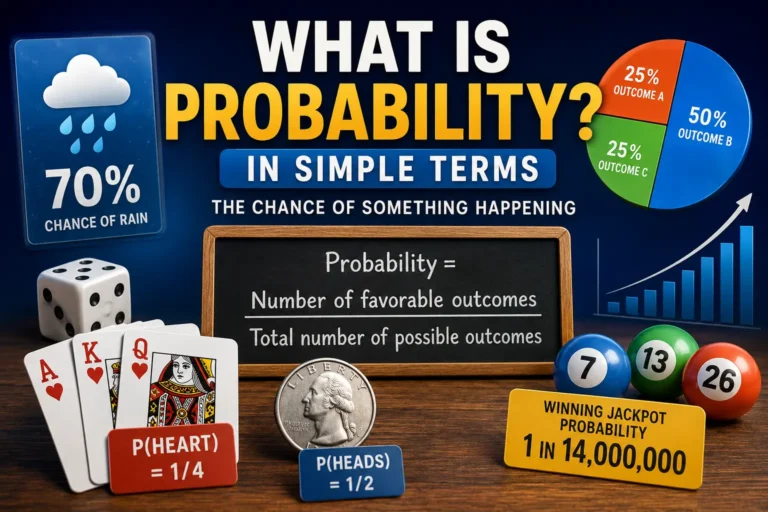
Probability measures how likely an event is, using a scale from 0 (impossible) to 1 (certain).
A few simple examples:
- A coin flip has a 50% probability of landing on heads.
- Rolling a six-sided dice gives you a 1-in-6 chance, or about 16.7%, for any specific number.
- Drawing one specific card from a standard 52-card deck gives roughly a 1.9% chance.
Probability theory includes several important concepts:
- The Law of Large Numbers, which states that as you repeat a random event many times, the results move closer to the expected probability.
- The Normal Distribution, often visualized as a bell curve, describes how many natural and social phenomena are distributed.
- Bayes’ Theorem, a formula used to update probability estimates as new information becomes available.
Statisticians test random number generators using these mathematical principles to check for hidden patterns, repeated sequences, or bias. A trustworthy RNG should give each outcome roughly equal chances over a large number of trials.
FAQs
Q1: Can a computer generate truly random numbers on its own? Not through calculation alone. Standard software uses pseudo-random number generators based on mathematical formulas. However, computers can capture true randomness from physical sources like electrical noise or radioactive decay.
Q2: What’s the difference between a PRNG and a TRNG? A PRNG uses a mathematical algorithm and a starting seed to create numbers that look random. A TRNG pulls randomness directly from unpredictable physical events, making it closer to true randomness.
Q3: Why do websites like Random.org use atmospheric noise? Atmospheric noise is a natural, unpredictable source that’s very hard to replicate or predict, which makes it useful for fair lotteries, raffles, and research applications.
Q4: How do random numbers protect my online data? Random numbers help generate encryption keys. Because these keys are unpredictable, it becomes extremely difficult for hackers to guess them and access sensitive information.
Q5: What is a “seed” in random number generation? A seed is the starting input value used by a random number generator. The same seed will always produce the same output sequence, which is why unpredictable seeds are essential for strong security.
Conclusion
Random numbers might seem like a small technical detail, but they quietly shape much of modern life. From securing your online banking to deciding the next card in a video game, randomness and probability work together behind the scenes.
True randomness comes from unpredictable natural events, while most everyday computing relies on clever mathematical formulas that mimic randomness convincingly. Understanding this difference helps explain why some systems, like banking and cryptography, need much stronger randomness than others, like music shuffle features.
Whether it’s a lottery draw, a secure login, or a simple dice roll, random numbers help make modern technology fairer, safer, and more engaging for everyone.